
A video introduction to the Vistogram
Here at Omnivisto we have been working hard on our software. As we go into 2025, we’re actively looking for early ad...


Why is it that every time I read any list of the common causes of project failure it never reconciles with my experience over the last 15 years working as a project manager?
Such lists are always going to face an uphill struggle because:
By my estimation project politics makes the grade in terms of something which is a leading cause of project risk. It is also something which the project management domain has never codified or written about in any reasonable format that I’m aware off.
We’re going to have to start with some nomenclature here otherwise, we are going to get nowhere.
Politics for me is anything used to make a decision other than the data (and yes, if you must, the correct data).
Politics arise when there is more than one answer to a question. This is where power, authority and influence can find an energetic ignition source. Mostly, this is about opinions. Sometimes it is about naked self-interest.
Thankfully, we can look to Ray Bradbury (yes that Ray Bradbury) for a solution.
“If you don’t want a man unhappy politically, don’t give him two sides to a question to worry him; give him one. Better yet, give him none.” [Fahrenheit 451]
I think it is during the production of the business justification where the threat of questions that have more than one answer presents the greatest risk to an investment. The reason for this is that the stakes are the highest at this point because mostly this about whether to do something or not. Whether to consolidate manufacturing in a single location or whether to invest in a new R&D project for instance. That is why a rigorous business case is the foundation to any good investment. This is the part of the activity where ‘doing the right thing’ is identified and validated. It’s the stage where vested interests tend to be most active too.
The slight snag here is that the project or programme manager might not be on the scene at the time the business case is being written so what’s to be done? The delivery team must diligently, review, validate and assure the business case for any questions that have more than one answer and get THE answer documented, reviewed and agreed.
The level of rigor you apply to this should be proportionate to the project’s context. Are there multiple stakeholders with divergent interests or viewpoints? What is the worst foreseeable outcome? What is the potential impact and likelihood of stakeholder politicking? If you’re taking on a project mid-flight, you’d do very well to spend some time on this.
In the chart below, I’ve tried to set out how I think the risk to an investment arising from political manoeuvring changes over time.
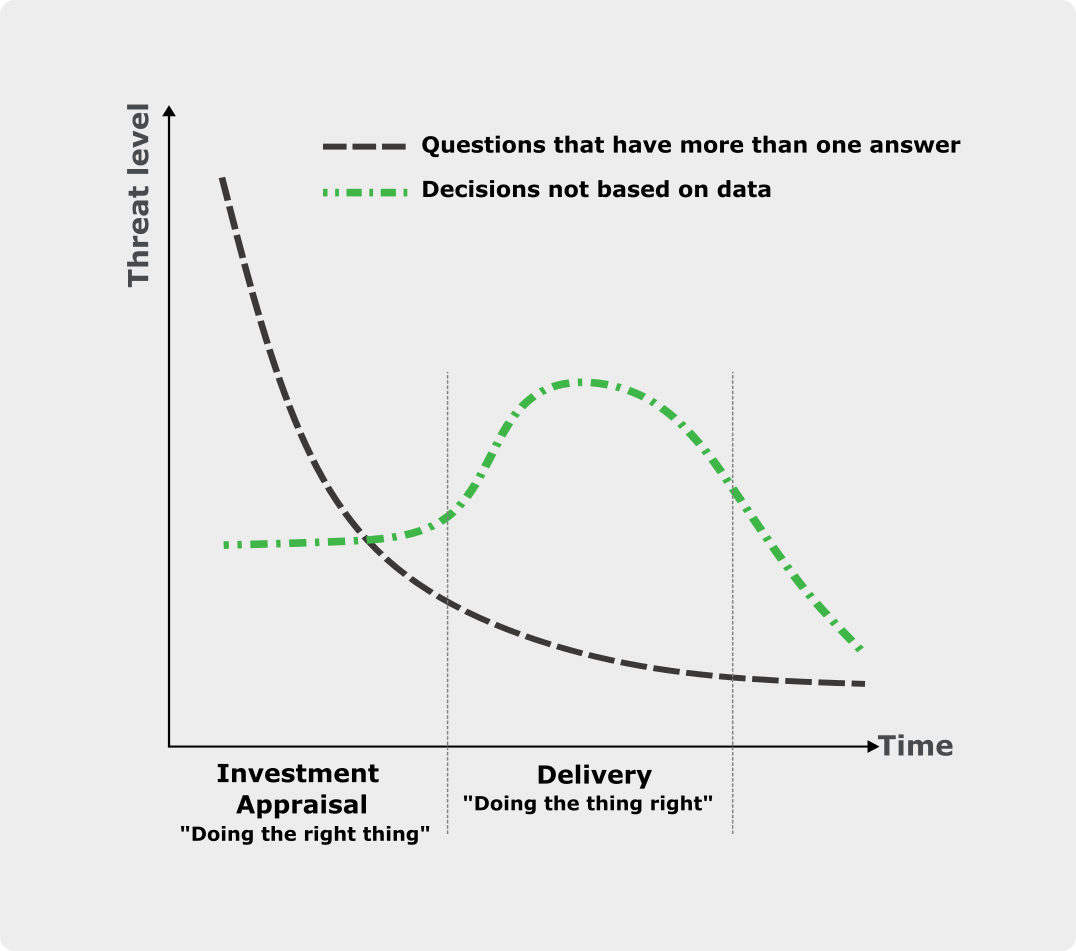
You’ll notice two lines on the chart above however. The whole ‘Questions that have more than one answer’ side of things is mostly about doing the right thing and this (again, mostly) sits in the investment appraisal space.
That’s not quite to say that the threat of project stakeholders answering the same question different ways goes to nil when delivery commences. But as the project ramps up and gets documented, there’s less scope for mischief.
What we are more faced with in the delivery space are decisions being made that are not based on the data. We now know what ‘doing the right thing comprises’ but we still have the opportunity for politicking around ‘doing the thing right’. We know for instance that we want a highspeed rail connection between two cities, but we do need to decide the finer points about the route. Do we bridge the river or tunnel underneath it?
There’s a bit of overlap here. The dimensions are a little bit distinct and a little bit the same.
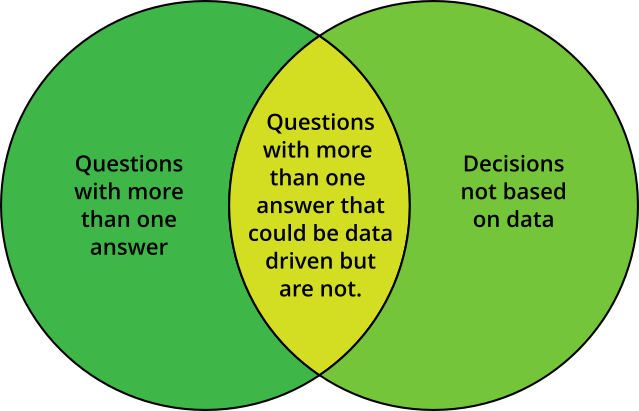
Addressing a propensity for decision makers to make decisions NOT based on the data is about good project management practices. It’s about requirements driven solutions. It is absolutely not about (in these lamentable times) “The answer is AI. Now what’s the question again?”. There are also themes here around conflicts of interest, codes of conduct and professional indemnity but that can all keep for another day.
It’s also about governance (i.e. what decisions are made where, by whom, in what forum and to what criteria?). Thanks to Steve Jenner for that succinct definition.
But crucially, it is about assurance and that’s just not a word you hear often enough in delivery settings. What level of confidence do we have that the design is fit for purpose? What testing and validation activities have we performed? How do we minimise the impact of the worst foreseeable outcome?
So – we have our first step in the process which happens early in the project lifecycle (or better yet, before it has even begun). This is where we make sure that questions have one, clear and unambiguous answer which is documented and solidified across all stakeholders. That’s not actually the project manager’s or programme manager’s job to fix but certainly they should identify any risks if they exist and get them addressed.
And, during project delivery we will have some possibility that decisions could be skewed if they are not based on data. Setting out ground rules and a bit of old fashioned ‘force of personality’ go a long way here. But, failing that, use the risk and issue registers to record deviations.
Keep in mind that it’s politics. It doesn’t follow rules and it will find ways to circumvent or dilute controls. So be alert and re-evaluate. Change of sponsor? Big change request into the project? Sweeping changes in the organisation which may result in the business case needing to be revisited? All of these things should have your sonar pinging.
Ultimately, the project or programme manager can’t stop determined political self-interest and avarice impacting an investment. What you can do is ensure that project management mechanisms are used to deter the likelihood and to identify the culprit(s) when it happens.
You might think some of the points here to be a little abstract. That all the project or programme manager needs to do is ‘stay in lane’. Not so in fact and if you read any of the APM, PMI or IPMA codes of conduct – you’ll see these themes embodied therein. IPMA’s is probably the clearest and I include an excerpt below.
Section 3 Commitment to Project Owners and Stakeholders
Section 3.3 – We are on our guard against any biases and unethical influences.
Omnivisto are the pioneers of the Vistogram – a novel and unique single view of all past, present and future change. The Vistogram is not (yet) a panacea to all political ills but it will answer the question “Who designed this and who signed it off?”. That’s a good start. 😉

Posted 02/01/2024
We maintain a vibrant blog which we hope provides different and new perspectives on a variety of topics.
Here at Omnivisto we have been working hard on our software. As we go into 2025, we’re actively looking for early ad...

What is a single view of everything worth? If you have a good answer to this – we’re all ears here at Omnivist...

I’m sure all founders love introducing their wares to new folks. I do too. At Omnivisto – we’re lucky to...

Our team is here to answer any questions you may have.